Showing posts with label day to day. Show all posts

April 11, 2011

NYC can Shop Chile!


Now you can get the Best of Chile in New York City! The Puro Chile shop features a wide range of products from crocheted wool shoes to merken infused avocado oil.  Funded from a variety of Chilean private sector organizations and supported by the Chilean government, Puro Chile hopes to open the doors in NYC to Chilean products and services, while spreading Chilean culture and enhancing its image in one of the world's most important cities.

We have tried both the AFE juice and Manka chutney and they are tasty!

The Puro Chile shop is located at 221 Centre Street and open Monday thru Sunday from 12pm to 7pm.
P: (212) 925-7876
E: info@puro-gourmet.com

April 09, 2011

Bike Parking Banned from Titanium Building

After a slight hiatus, Pencil In Hand regular posts are back!

MANIFESTO

Earlier this week I had a chance to feature a really cool project called the Bike Hanger designed by MANIFESTO Architects on ArchDaily.  I personally loved this project, the bright yellow structure, the utilization of space between buildings, the creation of vertical storage, and materials and power needed are recycled and human pedal power.

This project made the shortlist for the Seoul Cycle Design Competition 2010

designboom
In an interesting turn of events, later that same day I learned that the Titanium Building issued a statement notifying bicyclists that they would be banning bicycle parking on their property for cosmetic reasons! And on top of that, they will not be installing any bicycle parking of their own.

In a high traffic bike area, especially for week day work commuters, this seems like an ideal opportunity to create a visually interesting bicycle storage, however I guess to some surprise the design of the building in the first place is quite lacking and seemed to disregard site orientation and any type of streetscape/pedestrian presence.

Santiago seems to be continually taking one step forward and two steps back when it comes to bicyclists. Unfortunately there is still a long way to go when it comes to provide safe bikeways, storage, and therefore encourage more bike commuters rather than car commuters reducing air pollution.

Apparently they are a bit confused here!

January 06, 2011

Video: The Story of Cosmetics


I'm a huge fan of Annie Leonard's videos, informative and a bit playful the 15 minutes fly by and at the end you feel motivated to pick up the phone to call your representative and change those laws.  Also noteworthy is that this video applies to both men and women, as shaving cream, lotions, body washes are all included within this umbrella of laws (or lack there of should I say).


For more information take a look at Campaign for Safe Cosmetics

December 03, 2010

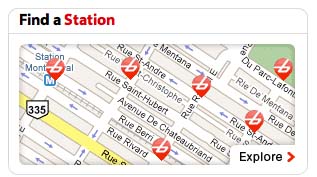
Bike Rental in Montreal

My friend Anne took these pictures of a BIXI station last week while in Montreal for Thanksgiving. (Thanks Anne!)


Montreal has this really great public bike system that is definitely worth writing about. In its transportation plan Réinventer Montréal, the Ville de Montréal wanted to provide different means of getting around Montréal. 
Given its immense popularity in Europe, the Ville de Montréal decided to make a public bike system one of the measures included in the plan. BIXI is viewed as a complement to the public transportation system and as an alternative to the car for residents and tourists throughout the city. 

Who can use BIXI?
You have to be at least 14 years of age and measure at least 1.24 metres (4'1") in height to use BIXI.


How long can I take a bike out?
You can take a bike out for a maximum of 24 hours.

Is the system in service throughout the year?
The system is in service three seasons of the year (spring summer, fall) from May to November. The stations are removed during harsh winter months.


BIXI offers gift certificates and a station map for your mobile. You can subscribe for a year membership or a BIXI - bus package. BIXI website also offers bike safety tips, weather updates, and a station location map.


December 02, 2010

Crumpled City Map Anyone?


CRUMPLED CITY™
Palomar
Crumpled City maps are soft, yet hard-wearing, waterproof and meant to be creased and crumpled. You can place the area that you’re interested in on the palm of your hand to spot street names then just screw it up, stuff it back into its case or your pocket, and carry on.

You can buy Crumpled City maps for London, Paris, New York, Rome, Berlin.  I vote Santiago as one of the next cities on the list!

Size 87x58 cm. Graphics with Alvvino


November 05, 2010

It's the Punkin Chuckin Time of Year

Well it's the Punkin Chuckin time of year...and one thing that Chile just doesn't have are pumpkins.  Yes they have zapallo, but it really isn't pumpkin the way we know it, therefore pumpkin pie doesn't taste quite the same.
© kittell
Every town seems to have their own way of celebrating the chucking of leftover halloween pumpkins, and I did have a chance a few years back to attend Morton, Illinois Punkin Chuckin Contest.  Held in a plowed field I couldn't believe the crowd and the chuckin devices.  Organized teams of boyscouts and high school science classes, as well as individuals and groups of friends teamed up to construct their catapults.  Good featured Delaware's version Punkin Chunkin, and you can check their article here.
Morton, Illinois is home to Libby's Pumpkin, where 85% of pumpkin is canned...who knew.  I also tracked down this video that shows a pumpkin being catapulted at a car in the field, one of the targets for the contest.  A little odd, but somehow festive!

Edison Pena on Letterman

November 5, 2010

Here is Edison Pena's interview on David Letterman last night, complete with Elvis sing along.

33 Heroes

November 5, 2010

Edison 'the runner' Pena is one of 33 Chilean miners who survived 2,000 feet below ground for 69 days.  His name seemed to be heard by everyone yesterday, making headlines on CNN, ESPN, and even Perez Hilton websites.  David Letterman scored the first interview with one of the rescued miners, and Pena will in NYC will be running this weekends ING New York City Marathon - 26.2 miles.  Before returning to South America he is also going to make a stop at Graceland in Memphis, Tennessee as they have invited him to the celebration of Elvis Presley's birthday.  Pena while under ground used Elvis Presley songs to workout and hold sing alongs while they anticipated their rescue.


The mine rescue was an amazing moment as car horns honked with excitement every time one of the miners reached the surface.  The Costanera Center Tower currently under construction here in Santiago is slated to be amongst the tallest in Latin America, and tallest in South America, upon its completion at over 250 mts.  The sign 33 Heroes was proudly displayed in support of the miners during the rescue efforts.

November 04, 2010

Architecture for Humanity in Stgo

November 4, 2010


Architecture for Humanity recently established a new chapter in Santiago, Chile.  Mision Urbana is hosting the chapter, and they recently participated in AFH's Global Forum held in NYC last month.

In response to the February 27th earthquake Nike + AFH will be teaming up for the chapters first project in the city of Talca.  For more details about Santiago's AFH Chapter follow the link.

October 27, 2010

New Subway Stops Planned


October 27, 2010


The President of Chile, Sebastián Piñera, recently toured the extension of Metro Line 5.  Seven new stations are scheduled to open early in 2011.  President Piñera also announced that the government is already working on new lines 3 and 6 of the subway system that will link the north of the capital and the districts of Providencia and Vitacura, respectively.

October 20, 2010

Santiago's Struggle with Green Space

October 20, 2010
parque forestal in Santiago Centro

A recent study of Santiago's green space revealed mixed reviews of meeting the World Health Organizations minimum recommendation of 9 square meters of green space per person.  Neighborhoods such as Vitacura have doubled the recommendations estimating 18.3 square meters, but over half of the remaining neighborhoods average 3 square meters or less!  This reveals a glaring gap in green spaces per inhabitant that exists in the Chilean capital.

So let's ask the question why is there such a large difference in green space per community?  The answer is not a surprising one as like many things it comes down to monies.  The distribution of green areas is nearly a direct reflection of the socio-economic of the city.  Each neighborhood functions as a separate entity when it comes to green space.  Architect and planner Ivan Poduje of Atisba states, "this calls for the authorities to restore the urban parks program which was inexplicably closed and should have been following the model of Parque Metropolitano de Santiago."  

sculpture park in Providencia

The difference between green space per person in Santiago (4 sqm) to lets say New York City (27 sqm) or Stockholm (87 sqm) is huge.  However if you look at Santiago compared to the rest of Latin America they are leading the pack.  Mexico City for example only averages 2 sqm per person. 

October 07, 2010

Underground Parking in the Capital City

October 7, 2010
In response to rapid growth of automobiles in Santiago, underground parking grew 20% in 2009 with continued expansion this year.  (Note: 42% of all of the automobiles in the country of Chile are located in Santiago alone!)  Most recently the opening of the Gabriela Mistral Cultural Center also resulted in the inauguration of 400 new parking spaces beneath.  Also this year the neighborhood of Vitacura has opened underground parking with 308 parking spaces to support the many restaurants along Vitacura Avenue. 
El Mercurio
According to the municipalities records the rise in automobiles being purchased is not consistent across the city, but is concentrated in five neighborhoods:  Santiago Centro, Las Condes, Providencia, Vitacura, and Puente Alto.  Some areas of Santiago have done a good job capitalizing on their geographical location and submersing their parking underground.  Santiago Centro, Las Condes, and Providencia have previously been the only neighborhoods to offer underground parking, now Vitacura will be included in that list.

Transportation experts agree that this is a good solution for Santiago, but they caution that underground parking not be the solution indefinitely.  They think that sooner or later parking should be restricted in some sectors or that prices for parking should sharply increase.  Also the cities of London, Tokyo, and Singapore would be good case studies - as they have been able to create a successful balance, not overwhelming their cities with automobiles.  


A focused approach on integrating the underground parking with other transport systems particularly the subway system will be key as Santiago continues to grow and adapt.  The integration of these two modes of transportation would help to decongest the highways and provide Santiago with cleaner air. 

Interactive Bicentennial Website

October 7, 2010

Check out these two great interactive websites from La Tercera and El Mercurio newspapers.  Even if you don't know spanish they are very visual and easy to navigate.  You can easily compare yesterday and todays photographs or see the icons of the bicentennial celebration.
Yesterday and Today  or Icons of the Bicentennial

October 06, 2010

Architecture Exposition in Parque Forestal

October 6, 2010
I finally had a chance to take a look at the architecture exposition in Parque Forestal today.  In celebration for the Bicentennial, over 80 photographs are displayed in large format.  The exposition provides a look at Santiago's evolution in architecture primarily focusing on the most national and symbolic buildings.  

The exhibit is open air, free to the community and will be available through October 10th.  So grab your dog and go for a walk in the park, while enjoying some architectural history of Chile!

Here is a great little video about the exhibit.  

September 30, 2010

Feria Ch.ACO


September 30, 2010
Ch.ACO poster
Casa de Lo Matta recently hosted the Contemporary Art Fair of Chile (Ch.ACO) which had over 40,000 people pass through its doors from September 24th thru 28th.  Ch.ACO is one of the most important cultural events in Chile and is held in Santiago every spring.
entrance to Ch.ACO

Nearly 50 galleries filled the space with Chile having 27 galleries themselves, and international countries included Peru, Colombia, Mexico, Brazil, Guatemala, Argentina, and Spain.
interior gallery spaces
 

Some of my favorite work came from the alumni of University Finis Terrae.  There was great use of color, some whimsy, texture, and recycled materials.
plastic bags stretched and painted on a canvas
nut casings in a semi-circle
bottle caps vertically strung on fishing line

This piece located in Sala Ch.ACO y Finlandia was interesting but just seemed like a serious waste of paper.
 

Ch.ACO invited Pablo Nunez, designer and visual artist to create a space specifically for their SACO store.  His concept revolved around creating a skin, sort of a protective membrane, with built in shelves to display SACO's design products.  The skin was comprised of recycled cardboard and accordingly to Nunez, "falls within the contemporary sensibility of what is sustainable.  In addition, there is a certain methodology when building in a do-it-yourself process, clearly reinforcing the ideas of self sustaining, eliminating waste, and valuing natural resource."  Nunez also produced pieces of furniture and decorative roosters all of which were made out of recycled cardboard as well.  The roosters were a mascot of this years Ch.ACO, appropriately incorporating agriculture, with environment and design concepts.

Urban Canvas

September 30, 2010


Check out and VOTE for your favorite Urban Canvas design by October 1st.  My favorite is Jen Magathan's My Urban Sky.  Her inspiration for her design, "A road trip from Michigan to Virginia inspired me to bring the Midwestern sky to the urban context. What would it feel like to walk down a crowded street and find yourself next to an open sky? My Urban Sky infuses the cityscape with modular vignettes of open sky."


Here's the explanation of the Urban Canvas Design Competition:
The urbancanvas Design Competition is a unique opportunity to challenge professional artists and designers to create printed artwork for temporary protective structures at construction sites that will beautify New York City's streetscape and promote maintenance of these structures. The competition seeks complementary designs for different types of temporary protective structures located on City-owned property: construction fences, sidewalk sheds, supported scaffolds and cocoon systems.
The urbancanvas Design Competition is an opportunity for eligible artists and designers who are United States residents and 18 and over to generate creative and compelling public art that will enliven construction sites and enhance quality of life while promoting safety. A distinguished jury of world-renowned artists, designers and civic decision makers will select a group of outstanding proposals to recommend to the Public Design Commission of the City of New York.  Following approval from the Design Commission, finalist artwork packages will be exhibited online and the public will choose the winning designs through an online vote. These winning designs will be available through the urbancanvas Pilot Program for property owners and developers to install on temporary protective structures located on City-owned property.
The New York City Department of Buildings and the New York City Department of Cultural Affairs, with support from the Rockefeller Foundation, have partnered to create this unique competition.

September 28, 2010

Wind Tower at Masdar

September 28, 2010

A wind tower used on the narrow streets of Masdar.  This technique of gathering air and transporting it to street level is one that has been used in previous Arab design - Foster + Partners modernized the wind tower which brings temperatures to a more bearable 80 degrees (rather than the typical 150).

Photograph courtesy Nigel Young/Foster + Partners

A city called Masdar

September 28, 2010


Masdar is the name of the newly opened sustainable community just outside of Abu Dhabi in the United Arab Emirates.  Designed by Norman Foster + Partners the first neighborhood of 3 1/2 acres began welcoming its new residents just last week.  The New York Times released a two page article about Masdar over the weekend, complete with a photograph slide show
Some of the highlights of the article for me:
  • Combining the latest sustainable technologies and researching old Arab building techniques 
  • Implementing narrow streets angled to maximize shade = Accelerated airflow through the streets and the feeling of 70 degrees cooler
  • 90 percent of the power to be used is expected to be solar and incinerating waste will generate the remaining power needed
  • Strategic placement of elevators (nearly out of sight) to encourage the use of stairs and walking
  • Use of electric cars that are beneath the city
  • Masdar will continue to be studied almost as an on going experiment, with some tweaking here and there


The article ends questioning this new city as it may successfully address some issues of sustainability, but misses the mark on integrated living.

"What Masdar really represents, in fact, is the crystallization of another global phenomenon: the growing division of the world into refined, high-end enclaves and vast formless ghettos where issues like sustainability have little immediate relevance.
That’s obviously not how Mr. Foster sees it. He said the city was intended to house a cross-section of society, from students to service workers. “It is not about social exclusion,” he added.
And yet Masdar seems like the fulfillment of that idea. Ever since the notion that thoughtful planning could improve the lot of humankind died out, sometime in the 1970s, both the megarich and the educated middle classes have increasingly found solace by walling themselves off inside a variety of mini-utopias."  Nicolai Ouroussoff


Photographs courtesy of THE NEW YORK TIMES.  NYT Sources: Duncan Chard; Renderings and photographs by Masdar, Foster & Partners (city plan and Masdar Institute), LAVA (Masdar Plaza and sunshades), Adrian Smith & Gordon Gill Architecture (Masdar Headquarters building), Zagato and 2getthere (automated car design)

September 27, 2010

Low cost design solutions

September 27, 2010


Recently featured in La Tercera newspaper, design students from the Universidad Catolica developed low cost day to day objects that can be used for people living in emergency housing.  Mediaguas, the name for emergency housing here, are typically 3m x 6m, and are home for many people still following the earthquake on February 27th.  Some of the objects they designed include a vertical garden, water transporter, dishwashing area, and a wardrobe for clothes.