After a slight hiatus, Pencil In Hand regular posts are back!
MANIFESTO
Earlier this week I had a chance to feature a really cool project called the Bike Hanger designed by MANIFESTO Architects on ArchDaily. I personally loved this project, the bright yellow structure, the utilization of space between buildings, the creation of vertical storage, and materials and power needed are recycled and human pedal power.
In an interesting turn of events, later that same day I learned that the Titanium Building issued a statement notifying bicyclists that they would be banning bicycle parking on their property for cosmetic reasons! And on top of that, they will not be installing any bicycle parking of their own.
In a high traffic bike area, especially for week day work commuters, this seems like an ideal opportunity to create a visually interesting bicycle storage, however I guess to some surprise the design of the building in the first place is quite lacking and seemed to disregard site orientation and any type of streetscape/pedestrian presence.
Santiago seems to be continually taking one step forward and two steps back when it comes to bicyclists. Unfortunately there is still a long way to go when it comes to provide safe bikeways, storage, and therefore encourage more bike commuters rather than car commuters reducing air pollution.
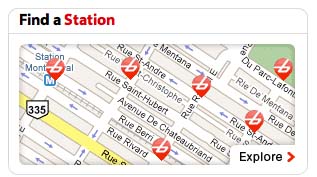
My friend Anne took these pictures of a BIXIstation last week while in Montreal for Thanksgiving. (Thanks Anne!)
Montreal has this really great public bike system that is definitely worth writing about. In its transportation plan Réinventer Montréal, the Ville de Montréal wanted to provide different means of getting around Montréal. Given its immense popularity in Europe, the Ville de Montréal decided to make a public bike system one of the measures included in the plan. BIXI is viewed as a complement to the public transportation system and as an alternative to the car for residents and tourists throughout the city.
Who can use BIXI? You have to be at least 14 years of age and measure at least 1.24 metres (4'1") in height to use BIXI.
How long can I take a bike out? You can take a bike out for a maximum of 24 hours.
Is the system in service throughout the year? The system is in service three seasons of the year (spring summer, fall) from May to November. The stations are removed during harsh winter months.
BIXI offers gift certificates and a station map for your mobile. You can subscribe for a year membership or a BIXI - bus package. BIXI website also offers bike safety tips, weather updates, and a station location map.
CRUMPLED CITY™ Palomar
Crumpled City maps are soft, yet hard-wearing, waterproof and meant to be creased and crumpled. You can place the area that you’re interested in on the palm of your hand to spot street names then just screw it up, stuff it back into its case or your pocket, and carry on.
You can buy Crumpled City maps for London, Paris, New York, Rome, Berlin. I vote Santiago as one of the next cities on the list!
The President of Chile, Sebastián Piñera, recently toured the extension of Metro Line 5. Seven new stations are scheduled to open early in 2011. President Piñera also announced that the government is already working on new lines 3 and 6 of the subway system that will link the north of the capital and the districts of Providencia and Vitacura, respectively.
In response to rapid growth of automobiles in Santiago, underground parking grew 20% in 2009 with continued expansion this year. (Note: 42% of all of the automobiles in the country of Chile are located in Santiago alone!) Most recently the opening of the Gabriela Mistral Cultural Center also resulted in the inauguration of 400 new parking spaces beneath. Also this year the neighborhood of Vitacura has opened underground parking with 308 parking spaces to support the many restaurants along Vitacura Avenue.
El Mercurio
According to the municipalities records the rise in automobiles being purchased is not consistent across the city, but is concentrated in five neighborhoods: Santiago Centro, Las Condes, Providencia, Vitacura, and Puente Alto. Some areas of Santiago have done a good job capitalizing on their geographical location and submersing their parking underground. Santiago Centro, Las Condes, and Providencia have previously been the only neighborhoods to offer underground parking, now Vitacura will be included in that list.
Transportation experts agree that this is a good solution for Santiago, but they caution that underground parking not be the solution indefinitely. They think that sooner or later parking should be restricted in some sectors or that prices for parking should sharply increase. Also the cities of London, Tokyo, and Singapore would be good case studies - as they have been able to create a successful balance, not overwhelming their cities with automobiles.
A focused approach on integrating the underground parking with other transport systems particularly the subway system will be key as Santiago continues to grow and adapt. The integration of these two modes of transportation would help to decongest the highways and provide Santiago with cleaner air.
Check out these two great interactive websites from La Tercera and El Mercurio newspapers. Even if you don't know spanish they are very visual and easy to navigate. You can easily compare yesterday and todays photographs or see the icons of the bicentennial celebration. Yesterday and Today or Icons of the Bicentennial
Check out and VOTE for your favorite Urban Canvas design by October 1st. My favorite is Jen Magathan's My Urban Sky. Her inspiration for her design, "A road trip from Michigan to Virginia inspired me to bring the Midwestern sky to the urban context. What would it feel like to walk down a crowded street and find yourself next to an open sky? My Urban Sky infuses the cityscape with modular vignettes of open sky."
Here's the explanation of the Urban Canvas Design Competition:
The urbancanvas Design Competition is a unique opportunity to challenge professional artists and designers to create printed artwork for temporary protective structures at construction sites that will beautify New York City's streetscape and promote maintenance of these structures. The competition seeks complementary designs for different types of temporary protective structures located on City-owned property: construction fences, sidewalk sheds, supported scaffolds and cocoon systems.
The urbancanvas Design Competition is an opportunity for eligible artists and designers who are United States residents and 18 and over to generate creative and compelling public art that will enliven construction sites and enhance quality of life while promoting safety. A distinguished jury of world-renowned artists, designers and civic decision makers will select a group of outstanding proposals to recommend to the Public Design Commission of the City of New York. Following approval from the Design Commission, finalist artwork packages will be exhibited online and the public will choose the winning designs through an online vote. These winning designs will be available through the urbancanvas Pilot Program for property owners and developers to install on temporary protective structures located on City-owned property.
The New York City Department of Buildings and the New York City Department of Cultural Affairs, with support from the Rockefeller Foundation, have partnered to create this unique competition.
Masdar is the name of the newly opened sustainable community just outside of Abu Dhabi in the United Arab Emirates. Designed by Norman Foster + Partners the first neighborhood of 3 1/2 acres began welcoming its new residents just last week. The New York Times released a two page article about Masdar over the weekend, complete with a photograph slide show
Some of the highlights of the article for me:
Combining the latest sustainable technologies and researching old Arab building techniques
Implementing narrow streets angled to maximize shade = Accelerated airflow through the streets and the feeling of 70 degrees cooler
90 percent of the power to be used is expected to be solar and incinerating waste will generate the remaining power needed
Strategic placement of elevators (nearly out of sight) to encourage the use of stairs and walking
Use of electric cars that are beneath the city
Masdar will continue to be studied almost as an on going experiment, with some tweaking here and there
The article ends questioning this new city as it may successfully address some issues of sustainability, but misses the mark on integrated living.
"What Masdar really represents, in fact, is the crystallization of another global phenomenon: the growing division of the world into refined, high-end enclaves and vast formless ghettos where issues like sustainability have little immediate relevance.
That’s obviously not how Mr. Foster sees it. He said the city was intended to house a cross-section of society, from students to service workers. “It is not about social exclusion,” he added.
And yet Masdar seems like the fulfillment of that idea. Ever since the notion that thoughtful planning could improve the lot of humankind died out, sometime in the 1970s, both the megarich and the educated middle classes have increasingly found solace by walling themselves off inside a variety of mini-utopias." Nicolai Ouroussoff
Photographs courtesy of THE NEW YORK TIMES. NYT Sources: Duncan Chard; Renderings and photographs by Masdar, Foster & Partners (city plan and Masdar Institute), LAVA (Masdar Plaza and sunshades), Adrian Smith & Gordon Gill Architecture (Masdar Headquarters building), Zagato and 2getthere (automated car design)
The 1710 Plan of Santiago was on exhibit over the holiday weekend. At that time Chileans constructed using adobe, shingles, and wood, also occasionally constructing with brick. Basic architecture made from local materials allowed them to repair and rebuild quickly in the earthquake prone country.
September 9, 2010
For the whole month of September Line 1 of Santiago's metro system will feature a train with a new graphics. The European Union Train (or "tren del la Union Europea") is joining in Chile's celebration of 200 years of independence. The train, as seen in the photo below, is quite flashy as it rolls into the station, with it's all blue paint scheme.
Photograph courtesy of Chile Bicentenario
The interior will highlight join projects between the EU and the Chilean government, and Chilean society. This will include the significant contributions that the EU made to Chile after the devastating February 27th earthquake.
Yesterday we hosted a birthday party for my husband, and as you can imagine there were a few last minute ingredients I needed for the new appetizer recipes I was trying out. I hurriedly left our apartment building for the grocery store I was pleasantly greeted with a brand new bicycle rack at the front of our building. I had the urge to turn around and head back up stairs to grab my camera, but there were time constraints. Just a good reminder that maybe I should keep a point and shoot on me all of the time.
Here is a picture of the new rack, a day late, but I'm still quite excited about it.
It is a beautiful, sunshine filled fall day here in Santiago. The leaves change ever so quickly here, skipping over the rich reds, oranges, and yellows that I love seeing during this season of the year. Excitingly I recently have spotted some amazing golden colors while walking town. It is so inspiring to see such vibrant and warm colors on a cool crisp morning!
Check out other pieces from my Color Series paintings.
In a very roundabout way I recently discovered People For Bikes. This new organization is uniting all bikers, no fitness level requirement! Their mission statement is as follows,'the goal of peopleforbikes.org is to gather a million names of support, to speak with one powerful voice—to let policy makers, the media and the public know that bicycling is important and should be promoted.'
PFB's rapid movement already (+6,000 in a few weeks, have signed their pledge en route to the million) suggests that it has possibly helped bridge the gap between a diverse group of riders throughout the nation, all intent on improving biking. Despite a variety of knowledge and skill levels, at the end of the day we all share a passion for biking, a need for safety, and an urge to continue adding and improving paths - making it possible to travel across your neighborhood, your city, your state, or the country.
image credit: PFB
Since our move to Santiago, we have found an opportunity to change many parts of the way we live. One in particular is the freedom to commute via public transportation, walking, and biking. This new way of commuting around town has proved to be rewarding in so many ways - exercising, fresh air, after a day in the office staring at a computer screen smelling the trees and seeing some nature is a big thank-you!, getting to really know the neighborhood, people watching, picking up some bread or milk with ease, and man it just feels good to say I biked/walked to work.
I think of my small hometown. What a great little place it is, but when visiting I realized quickly how limiting it is when it comes to commuting via bicycle or by foot. Sidewalks only reach so far and there is a lack of connectivity, and the only bike paths are located in the parks. Full of two lane roads, you can surly ride your bicycle, but your safety at times is questionable. My brother for instance often used his bike to commute to a summer job. One day en route to return home, he lost control of his bike due to loose gravel and holes as a result of a tar/chip day. The result was flying airborne and a broken arm. (busted summer and quarterback career as he tells the story).
Now fast forward 20years, the result would be similar - still no bike paths or sidewalks in high traffic areas for bicyclists and walkers/runners.
Chilean bikers struggle with similar problems, a need for safety and a network of paths connecting neighborhoods. Slowly the city of Santiago is improving and adding bicycle lanes, and more people are commuting in their suit and tie to work. Surprisingly, the smaller towns here in Chile tend feature great bicycle connectivity. We have visited a number of towns that have very well defined bicycle paths to help provide a safe way of commuting for their residents. It is impressive how the rural areas have successfully addressed the issues of safety, commuting flexibility, and rising gasoline prices. Young and old now can commute to work, run errands at the post office or market, or take a sunday drive on their bicycle.
Back to People For Bikes, check out there video: 'We're all united by a shared passion: bikes.'
November 29, 2009
Local artists and bici enthusiasts gathered this weekend in the Centro. It took me a little while to find the location, but it was well worth the extra effort. Located in Plaza del Corregidor, a small cobblestone and concrete plaza surrounded on three sides by buildings and a fountain in the middle, this was a great location to grab a drink and discuss bicis. There were lots of cool fashions for getting around in, my favorite - leg bands - featured above and designed by N Bicicletas. Also there were free repairs being offered for your bike, to bad I took the bus instead of riding my bike down. It could have really used a tune-up!
November 15, 2009 Every first Tuesday of the month at 8pm the cyclists are out, flashy new bicis, people in costume with a decorated bike, others with an old standby. Some people even rent a bike just to participate! A different location a different route, but always the streets are closed and the police escort some 100+ cyclists.
A number of organizations are helping to encourage the use of bicycles as a real form of transportation here. Furiosos is a group educating Chileans about cycling. Topics they cover are bike safety awareness, encouraging the development of bike paths, and even communicating that a bike with a motor is not a bike.
It was quite exciting to participate in this monthly ride (8pm is rush-hour here). Cars waited as we rode by and dominated the streets. People cheered from their balconies and we cheered back from our spot on the pavement.